In Ontario, all occupants of every vehicle are required by law to wear seat belts (with a few, very limited exceptions: see the MTO driver’s handbook for more details). Drivers must ensure that they and all passengers below the age of 16 are safely buckled up. Drivers are also required to ensure that younger passengers travel in appropriate seats: infant, toddler or booster seats must be used and properly secured according to the age of the children in the vehicle. This law applies even if the children are not the driver’s children and even if the children’s parent(s) give ‘permission’ to drive their children without proper safety seats. It is the driver, not the children’s parent(s), who will be charged if the children are not properly buckled up. Passengers 16 years of age and over are responsible for their own seatbelts and can be charged if not properly buckled up.
A flashing red beacon above an intersection means:
A flashing red beacon above an intersection is essentially the same as a four-way stop sign. Drivers approaching from all directions are expected to come to a full stop and yield right-of-way just as they would at an intersection with a four-way stop.
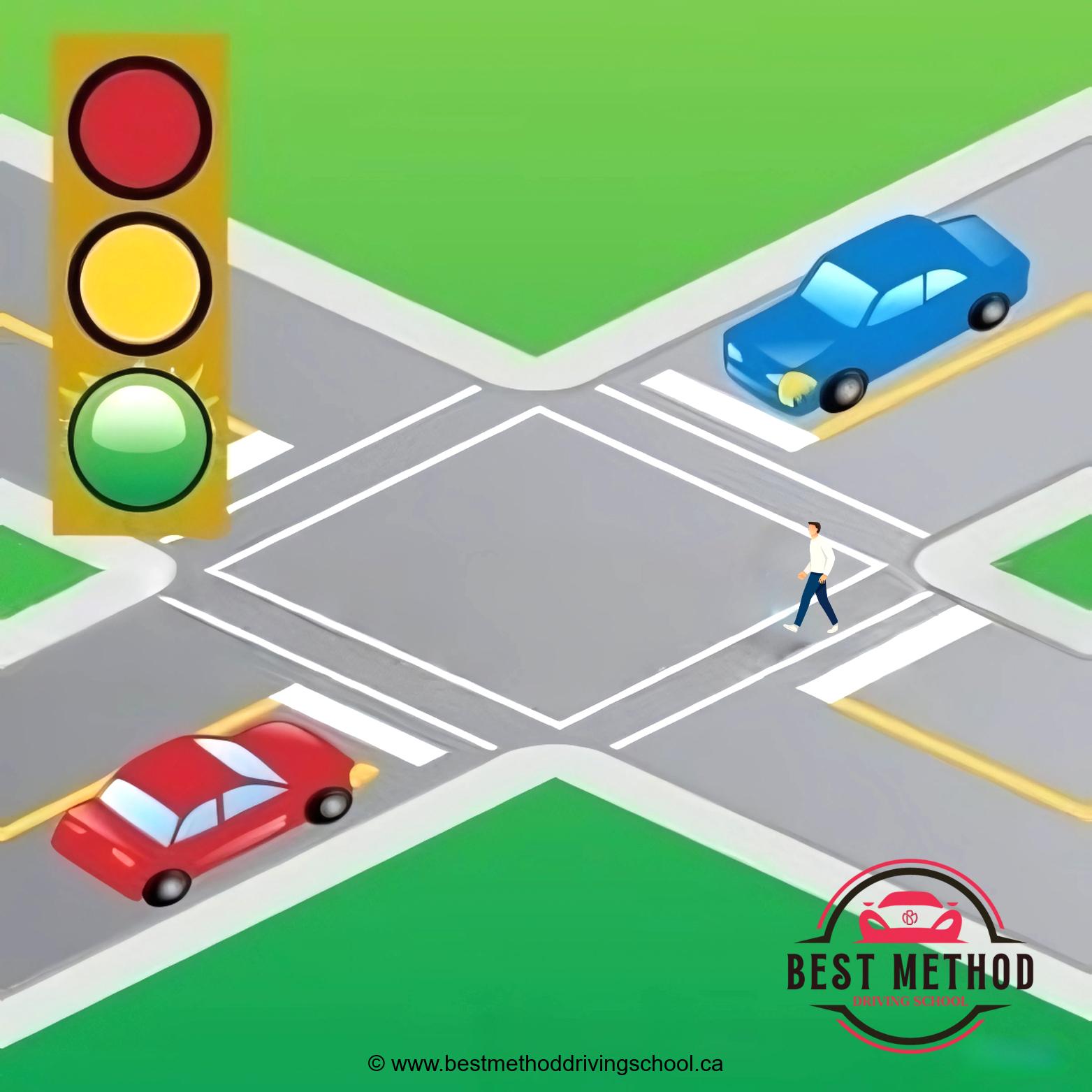
Who has the right-of-way over all others at an intersection when the light is green?
Pedestrians legally have the right-of-way over vehicles when crossing with the light. Pedestrians crossing against the light do not legally have the right-of-way, but even if pedestrians are in the intersection illegally, drivers must yield to them so as not to cause an accident.
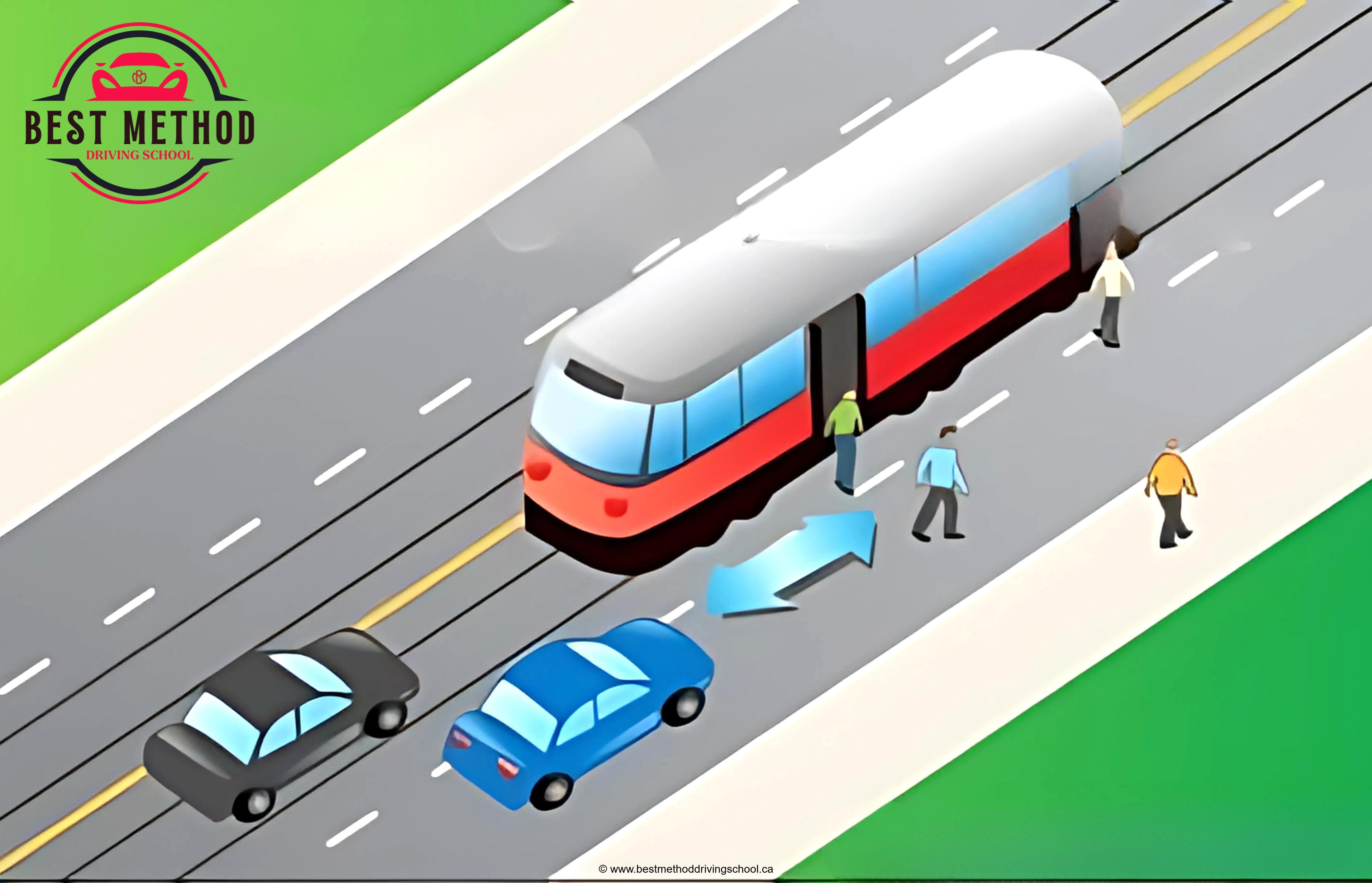
When a streetcar is stopped to take on or discharge passengers where there is no safety zone, what does the law require drivers to do before passing the streetcar?
By law, drivers must stop the entire time the doors are open on a streetcar, even if there appears to be no passengers getting on or off the bus. There may be passengers disembarking more slowly than others or people approaching the streetcar to board it. Streetcar drivers keep doors open to accommodate these people, who might not be visible to drivers of other vehicles, so it is important for drivers to remain stopped until the doors close.
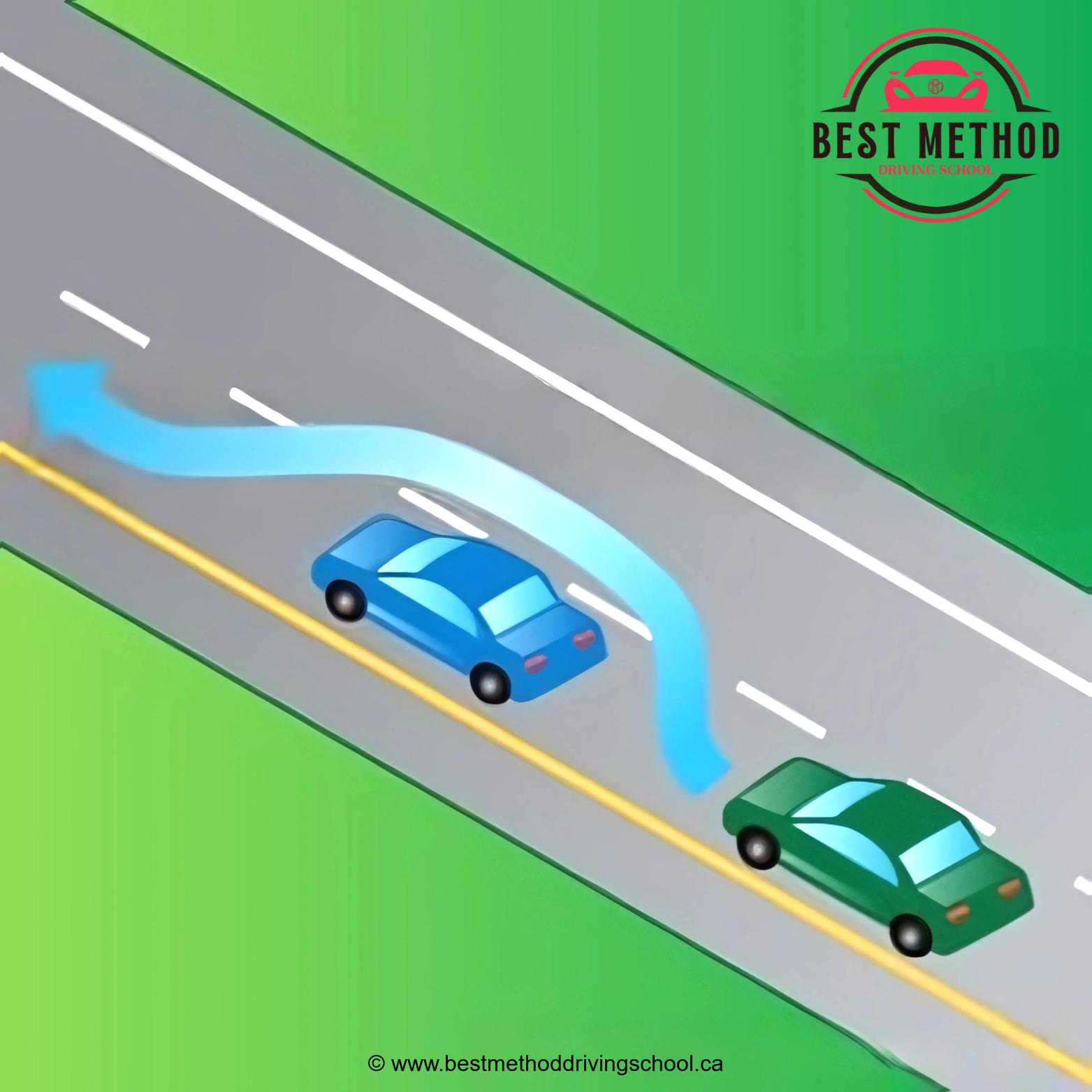
If an emergency vehicle with lights on and sirens sounding is travelling on a street that allows for two-way traffic, what does the law require drivers to do?
When all vehicles driving in both directions correctly pull off to the right, emergency vehicles are able to proceed quickly to their destination, which may save lives. Drivers in the left lane on roads with four lanes of traffic must use caution when pulling to the right so they do not hit vehicles that may already be in the right lane. Emergency vehicles often travel along the middle of the road and sometimes use oncoming traffic lanes to get through intersections. Drivers should not drive on until emergency vehicles have passed, and should use appropriate caution when accelerating back to roadway speed, especially if a lane change is required.
A person whose driver licence is under suspension, may
If a driver’s license is under suspension, it is the same as if the driver does not have a license. It is illegal to drive without a license or with a suspended license, regardless of the circumstance. Even in an emergency, drivers must not drive with a suspended license: they should call 9-1-1 for appropriate emergency assistance.
When a right turn against a red signal light is permitted, what does the law require drivers to do before entering the intersection and making the turn?
All red light signals and red stop signs require drivers to come to a complete stop before entering the intersection. When right turns are permitted at a red light, perform a complete left-center-right check for traffic before entering the intersection to be certain that it is safe to turn.
On approach to intersections with a flashing yellow beacon, drivers should scan the intersection and proceed only if the way is clear. If there is traffic near the intersection, drivers may need to stop and yield the right of way to other vehicles. Always be prepared to stop when approaching an intersection with a flashing yellow beacon.
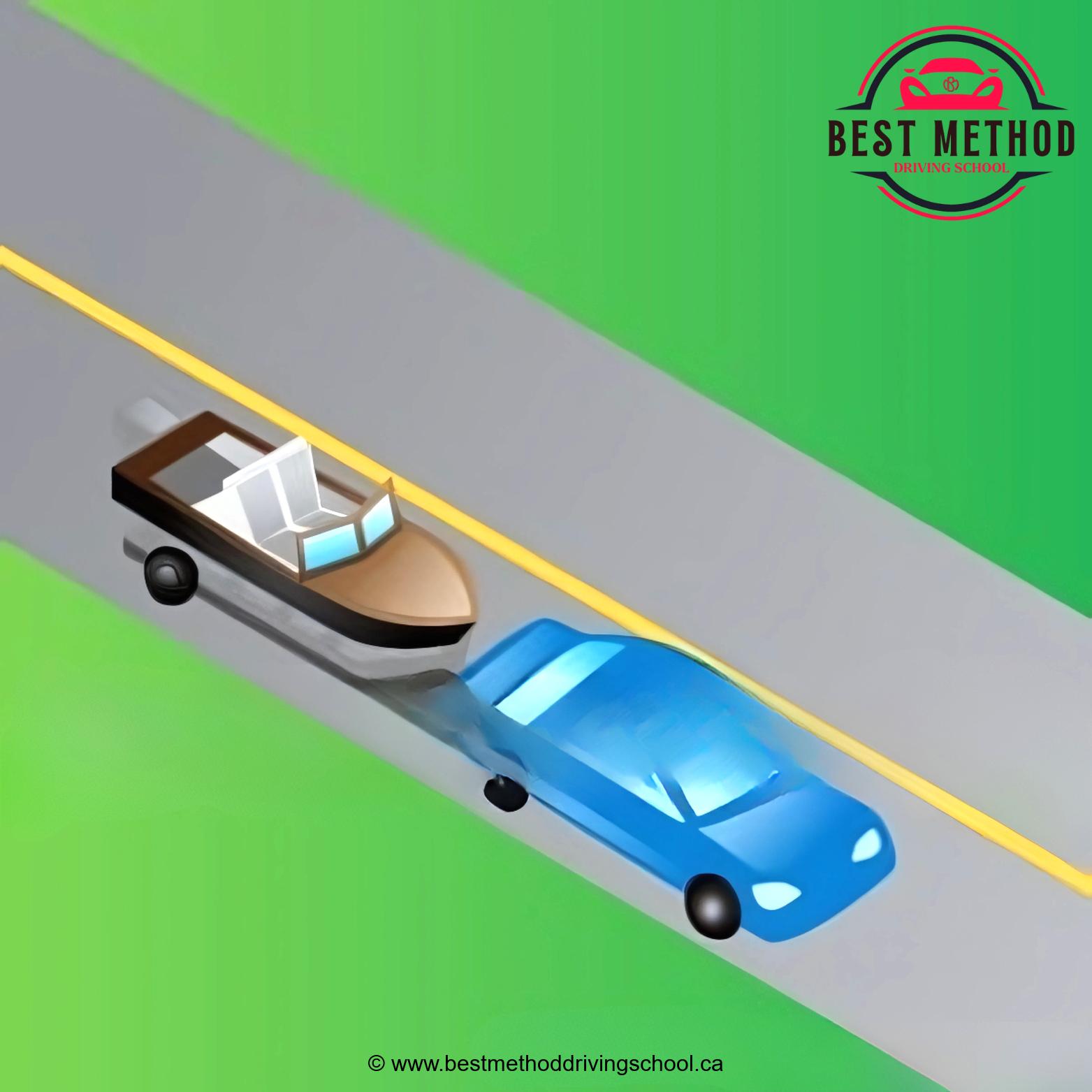
When towing a trailer or boat, the driver of a motor vehicle is not permitted to carry the following in the trailer or boat:
It is dangerous to carry people in a trailer or boat. Trailers and boats are more subject to damage in an accident. People in trailers or boats are at great risk of serious injury or death in the event of an accident.
Are drivers responsible for their passengers buckling up?
Drivers must ensure that all passengers below the age of 16 are safely buckled up. Drivers are also required to ensure that younger passengers travel in appropriate seats: infant, toddler or booster seats must be used and properly secured according to the age of the children in the vehicle. This law applies even if the children are not the driver’s children and even if the children’s parent(s) give ‘permission’ to drive their children without proper safety seats. It is the driver, not the children’s parent(s), who will be charged if the children are not properly buckled up. Passengers 16 years of age and over are responsible for their own seatbelts and can be charged if not properly buckled up.
High Occupancy Vehicle (HOV) lanes on provincial highways are reserved for vehicles with how many occupants?
HOV lanes are for vehicles with higher occupancy. The intention is to encourage carpooling, thus reducing the number of vehicles on the road. Drivers who carpool are ‘rewarded’ with these special lanes where there is less likelihood of traffic congestion, so they are able to travel at or near posted speeds and get to their destination sooner. HOV lanes are not to be used as ‘Speeding’ lanes. Some drivers ‘tailgate’ vehicles which are driving at the posted speed limit in HOV lanes because they want to speed. It is illegal to tailgate other vehicles, and it is illegal to speed. If a driver is being tailgated and is concerned about safety, the driver should signal and pull over to the closest right lane when lane markings permit and it is safe to do so.
Allowing space between the vehicle and the cyclist ensures the safety of the cyclist. Cyclists need space for a number of reasons: wind turbulence from passing vehicles may affect cyclists; cyclists may have to move over on the road to avoid grates or potholes, and so on.
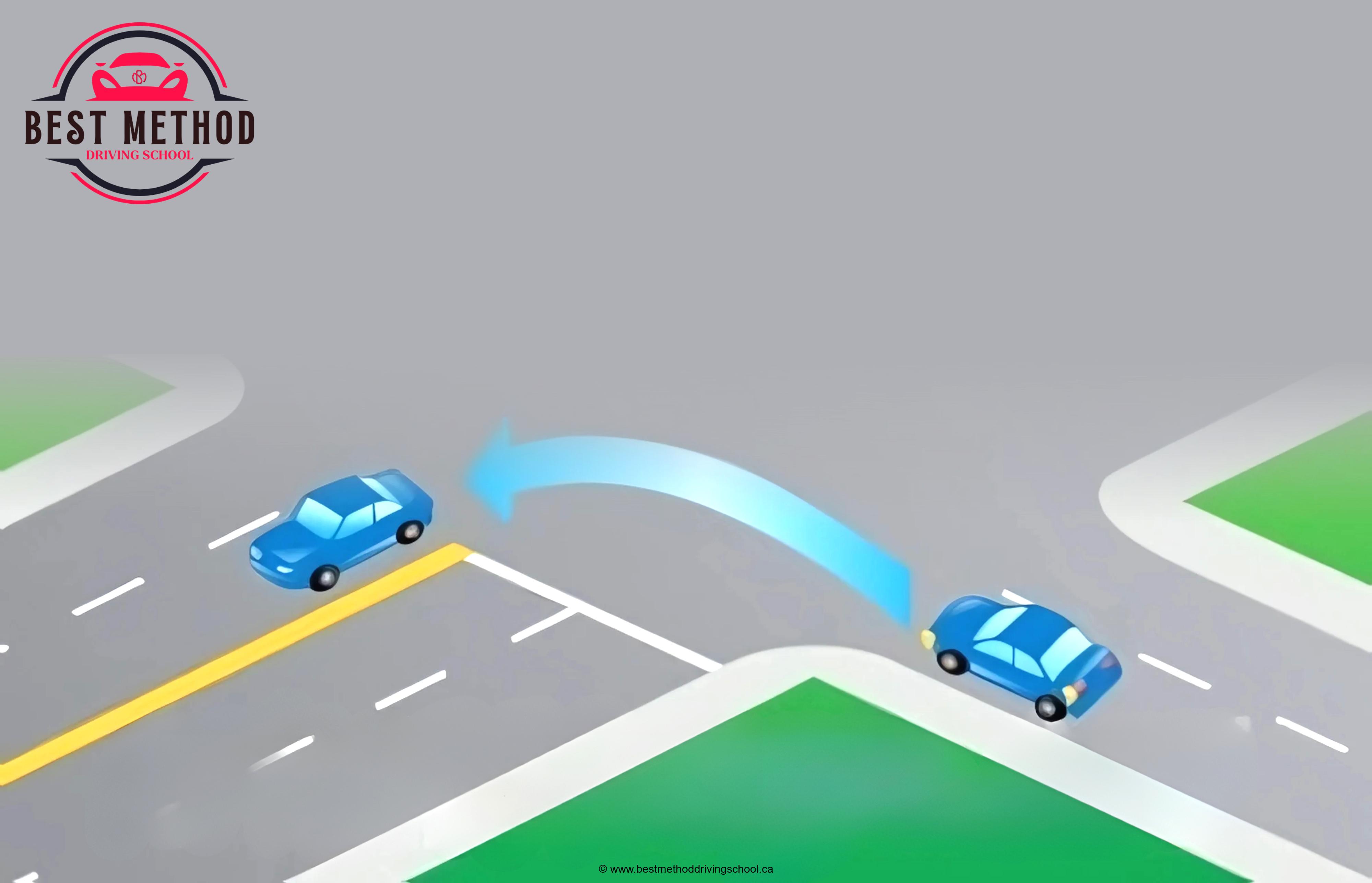
How many meters in both directions must drivers be able to see in order to make a legal U-turn?
Good visibility is important in making U-turns. Drivers must ensure that they have sufficient time to complete the U-turn and accelerate to proper driving speed, so they must be able to see far enough in both directions to determine that they will have sufficient time to perform the manoeuver.
Where there are no posted speed limits, the maximum speed in cities, towns and villages is:
All drivers are expected to know and adhere to this speed limit. Ignorance of this law will not be accepted as an excuse if a driver is caught driving over this limit.
It is important to use turn signals whenever making a change in any direction, whether turning onto a different roadway, changing lanes, or backing up in a direction other than the direction the vehicle is headed. Turn signals are the main way that drivers communicate with pedestrians and other drivers. Safe drivers always use turn signals and always ‘read’ the turn signals of other vehicles on the road.
When arriving at an intersection which has no stop line, crosswalk or sidewalk, where must drivers stop?
The edge of the intersection is the correct place to stop. Stopping a little into the intersection can cause the car to be hit by vehicles travelling through the intersection. Drivers stopping too far back from the intersection will not be able to do a proper check for pedestrians or oncoming traffic.
If a driver is caught driving with a blood alcohol concentration (BAC) from ----------------, the police can immediately suspend the driver?s license up to three days for a first occurrence.
Driving after drinking is dangerous. Every drink of alcohol can affect judgment and result in slower response time. Since each person is affected differently by alcohol, depending on body mass, food consumption, etc., the best choice is always to refrain from driving after consuming alcohol. Drivers who expect to drink must always have a plan for a safe ride home. Taking a bus, or a taxi, or getting a ride from a designated driver who does not drink are all safe options for travel after drinking.
When lights are required, drivers must use low beam headlights when following another vehicle within what distance?
Low beam headlights are aimed lower to the ground than high beam headlights. Low beams do not provide as much visibility into the distance as high beams so many drivers choose to use high beams when traveling at night on roads which do not have streetlights. High beams, because they are aimed higher, can temporarily blind drivers ahead of the vehicle, as well as drivers of oncoming vehicles. It is both a courtesy and an act of safety to switch from high beams to low beams while driving behind another vehicle or toward an oncoming vehicle.
If two vehicles arrive at an uncontrolled intersection at approximately the same time, the right-of-way should be given to:
Keeping in mind the term “right-of-way” reminds drivers that, legally, the vehicle approaching from the right must be given the right-of-way. Drivers should always use caution when entering an intersection even if they legally have the right-of-way. Other drivers might enter the intersection first; be certain to complete a ‘left-center-right’ check of the intersection and establish eye contact with other drivers or look at other vehicles’ wheels to ensure that other drivers have stopped and do not intend to enter the intersection before their turn. If another driver does enter the intersection incorrectly, the safe thing to do is yield to that driver in order to avoid a collision.
Passing on the shoulder of a roadway should only be done when passing a vehicle turning left, and only if the right shoulder is paved. Driving on an unpaved shoulder is dangerous; the shoulder may be too soft to accommodate a vehicle or it may not be wide enough to accommodate a vehicle. In those cases, the vehicle passing on the shoulder could end up in a ditch, could become stuck on the shoulder, could crash into rocks or trees, etc.
If a signal light changes from green to amber as a driver approaches an intersection, what should the driver do?
The expression “Green means go; yellow means go faster” is incorrect, and gives drivers the wrong idea when approaching an intersection as the light turns amber. In every case where it is safe to do so, drivers must make a full stop at the intersection and wait for the next green light before proceeding. If it is not safe to stop, drivers should continue through the intersection, exercising great caution as there may be oncoming traffic attempting to turn left, or even drivers from the other street ‘jumping’ the green light (proceeding through the intersection before the light has actually changed green). Always perform a ‘left-center-right’ visual sweep of intersections before driving through them.
What lane of traffic should drivers use when they intend to make a right-hand turn?
Turning right from the appropriate lane is an important safety measure for both the driver of the vehicle and for other drivers on the road. It is dangerous to attempt to turn right by cutting across other lanes of traffic travelling in the same direction. If there are vehicles in the other lanes, the driver turning right will likely be in an accident involving those vehicles, or could cause other accidents when drivers of those vehicles take evasive action to avoid a collision with the driver.
When it is safe to do so, passing other vehicles on the right side
When driving on a multi-lane roadway, drivers in right lanes may pass traffic driving in lanes to the left provided it is safe to do so. Generally, the leftmost lane to the center line is intended for passing. After passing, drivers should move to the right lane(s) to permit other, faster drivers to pass. It is helpful if drivers follow this general rule of the road, but it is not required by law.
When does the law require lights on vehicles to be turned on?
Legally, vehicle lights must be used during these hours, and at any time when visibility is poor. Newer cars are usually equipped with daytime running lights to ensure they are clearly visible to other drivers at all times. It is safest to use the vehicle’s full lighting system at all times, but it is not required by law.
Upon approaching a Yield sign, what does the law require drivers to do?
The word ‘yield’ means to give way; drivers are required to ‘give way’ at yield signs. Drivers must yield to oncoming traffic already in the lane they plan to enter. Sometimes drivers must come to a stop and wait for traffic to clear. If, while slowing down on approach to the yield sign, the driver visually confirms that there is no oncoming traffic, the driver is not required to stop, and may smoothly merge into the lane. Drivers should always use any merge lane present to adjust their speed to the posted speed of the new roadway, or to the speed of traffic if it is slower than the posted speed.
In what lane must drivers be before making a left turn from a one-way street?
On a one-way street, all traffic is expected to drive in the same direction. Turning left from the left-most lane means that the driver does not have to cut across other drivers on the roadway. It is dangerous to attempt to turn left by cutting across other lanes of traffic travelling in the same direction. If there are vehicles in the other lanes, the driver turning left will likely be in an accident involving those vehicles, or could cause other accidents when drivers of those vehicles take evasive action to avoid a collision with the driver.
Upon approaching a stop sign, what does the law require drivers to do before entering the intersection?
Drivers must come to a complete stop before entering an intersection controlled by stop signs. Always use caution at these intersections, driving defensively to avoid being in an accident if other drivers do not observe this law.
When must drivers stop for school buses on roads with a median?
Stopping for school buses is the law; this law is designed to protect school children who need to cross streets to get on or off the bus. Drivers are required to know the law and stop for school buses. Failure to stop at the appropriate time and place could result in injury or death to children who may be crossing the roadway and will result in criminal charges to the driver of the vehicle. Drivers should always use caution near school buses because some children may not be aware of other traffic on the road.
When a police officer signals a driver to pull the vehicle over:
Drivers must always obey signals from police officers, whether the police officer is on foot, or in a police cruiser. If a police officer signals a driver to pull over, the driver must slow down, signal if necessary, pull as far to the right as safely possible, and come to a complete stop as quickly as safely possible. Failing to stop for the police is not a joke: it is a crime punishable by law. When stopped, drivers will almost always have to show proof of their driver’s license, vehicle ownership and insurance. By law, drivers are required to carry these documents with them at all times when operating a motor vehicle. Cooperating with police officers is important for the safety of the driver, any passengers in the vehicle, and the police officers.
Emission testing is used mainly to determine if a vehicle is grossly polluting the environment. Since this often happens with older vehicles, vehicles that have passed a certain age are required to undergo emission testing before the registration can be renewed. If testing determines that the vehicle is grossly polluting the environment, registration is not renewable until appropriate repairs are made to reduce emissions. Drivers should ensure that regular maintenance is performed to help reduce harmful emissions from their vehicles.
On a roadway where traffic is moving in both directions, in what lane must a driver be before making a left turn?
Turning left from the appropriate lane is an important safety measure both for the driver of the vehicle and for other drivers on the road. It is dangerous to attempt to turn left by cutting across other lanes of traffic travelling in the same direction. If there are vehicles in the other lanes, the driver turning left will likely be in an accident involving those vehicles, or could cause other accidents when drivers of those vehicles take evasive action to avoid a collision with the driver.
When the traffic signal light facing a driver is red and the driver intends to go straight through the intersection, what must the driver do first?
Drivers are not permitted to proceed through an intersection when they are facing a red light. By law, drivers must wait for the light to turn green, check that the intersection is clear, then proceed carefully through the intersection.
The term acceleration lane identifies the purpose of the lane: to enable drivers to accelerate up to highway speed so that drivers may merge smoothly with highway traffic. It is dangerous to enter a highway when travelling too slowly. It is also dangerous to enter highway traffic in an erratic manner. Merge smoothly, as traffic permits.
 Our Driving Tests