Drivers must switch to low beam headlights while driving a vehicle at night if:
Where roadways are not lit, high beam headlights enable drivers to see further ahead. High beam headlights are aimed higher, so they can blind drivers of oncoming vehicles as well as drivers of vehicles ahead. Safe and courteous drivers always switch to low beam headlights when approaching an oncoming vehicle or a vehicle ahead of them.
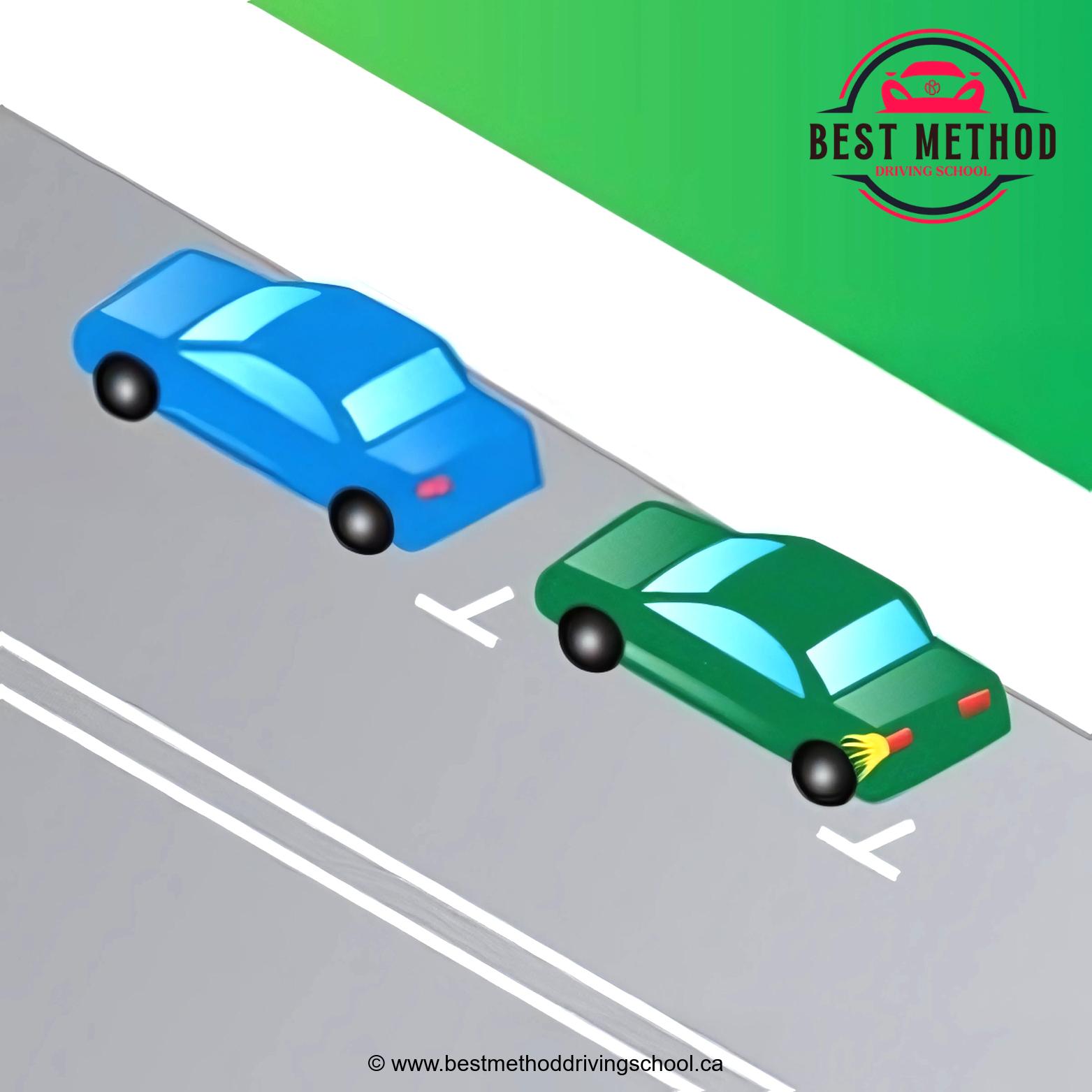
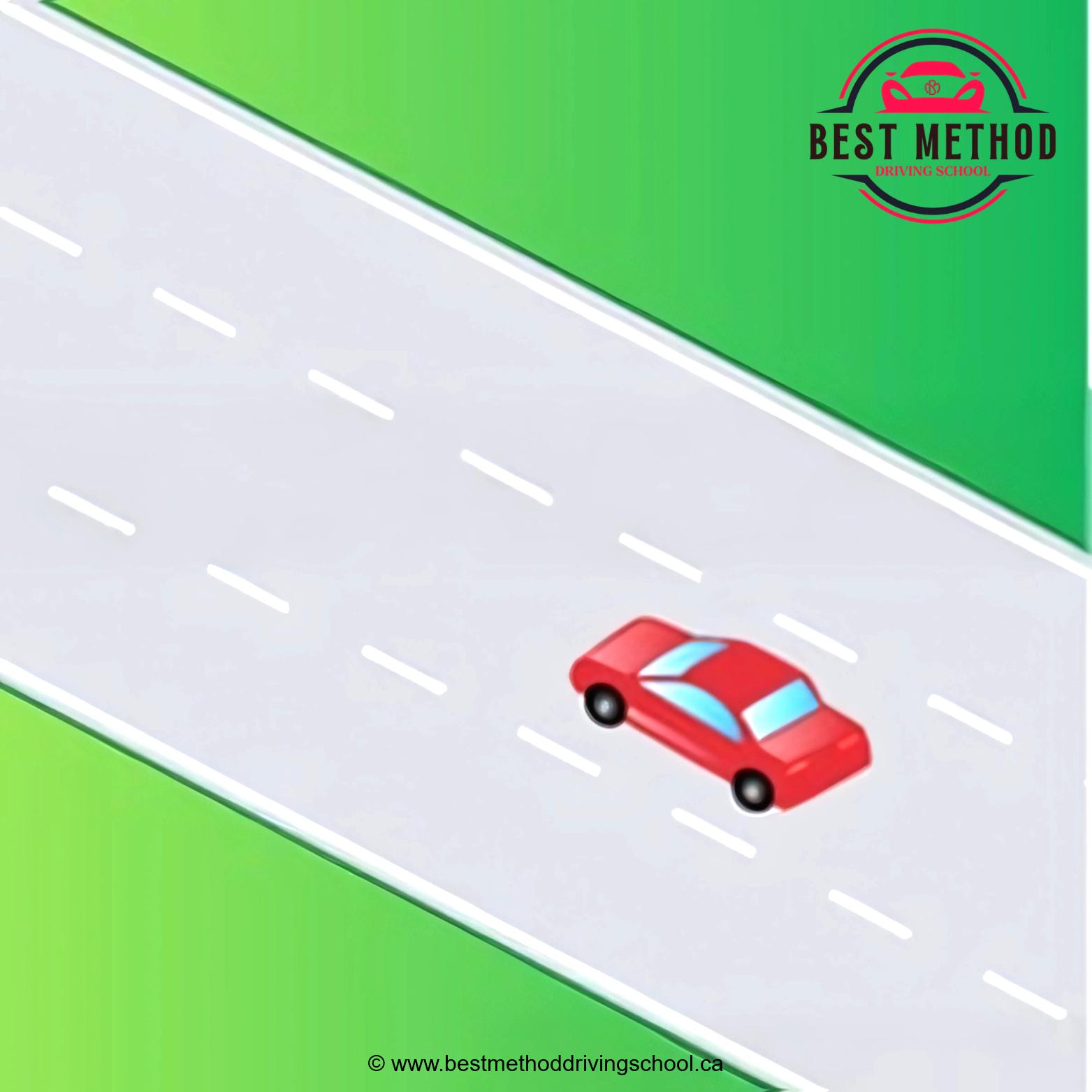
Entering a live lane of traffic improperly can be dangerous. Drivers should begin by signaling their intention. Next, drivers should complete a mirror and shoulder check to determine whether there is oncoming traffic. When the live lane of traffic is clear, drivers should enter the lane and smoothly accelerate to the appropriate speed.
Unless turning left or passing another vehicle, drivers should:
The right lane of roadways is intended as a driving lane, while the left lane is intended as the passing lane. Drivers should remain in the right lane unless passing. Once drivers have passed another vehicle, they should pull back into the right lane to permit other vehicles to pass as well.
Under all conditions drivers should travel at a speed that will allow them to:
The posted speed limit is intended to be the maximum speed drivers should use; under unfavorable conditions, drivers should reduce speed accordingly. This could occur when driving in heavy rain that causes reduced visibility. When driving in heavy traffic that is moving quickly, drivers should not travel above posted limits, and should ensure that they are able to stop within a safe distance of other vehicles.
When approaching vehicles that leave their high beams on at night, drivers should:
Drivers can be temporarily blinded by the high beams of oncoming vehicles.? To avoid this, drivers should not look directly at the headlights, but rather up and slightly to the right of the oncoming vehicle's headlights.? It is dangerous for drivers to flash their own high beams at drivers of oncoming vehicles, as those drivers might be temporarily blinded as well, increasing the potential of a collision.
Reversible lanes are lanes in which traffic may travel in either direction, depending on the overhead signal displayed (a green arrow or a red X). Reversible lanes are used to improve traffic flow during rush hours.
Every time drivers park, they must do so in a way that ensures the vehicle does not enter traffic if it moves unexpectedly. Parking downhill with the front wheels turned towards the curb ensures that the curb will help stop the vehicle if it moves ahead. Parking downhill with the front wheels turned towards the right shoulder ensures that the vehicle will turn further onto the shoulder rather than into live traffic if the vehicle moves ahead.
What is the minimum following distance drivers must maintain from an emergency vehicle that has its lights or sirens on?
Emergency vehicles with lights or sirens on need to arrive at their destination as quickly as possible. They may have to change course suddenly to avoid vehicles ahead, or to use an alternate route if their original one is blocked. Drivers must maintain a safe travelling distance behind emergency vehicles to enable these vehicles to travel safely at higher speeds.
What must drivers do before entering a highway from a private road or driveway?
Extra caution is required when entering a highway from a private road or driveway. Drivers must take into account the fact that highway traffic is travelling at higher speeds than local traffic, so drivers must ensure that they have enough time between oncoming vehicles to enter the highway and accelerate to the speed limit. Drivers who enter a highway without yielding to other vehicles will likely become involved in a collision, since highway drivers are travelling at higher speeds and may not have time to slow down enough to avoid colliding with them.
It is more dangerous to drive at the maximum speed limit at night than during the day because:
While drivers should be cautious and alert at all times, nighttime driving has unique challenges, the greatest of which is reduced visibility. Headlights, even high beam headlights, cannot provide the same visibility as daylight. Other hazards include the greater likelihood of deer crossing country roads, as well as the greater possibility of fog. It is possible to 'overdrive' the headlights: this occurs when drivers travel at speeds that are too fast to allow proper processing time given the visibility provided by their headlights. Drivers should always adjust their speed to the road conditions they encounter.
If a front tire goes flat, the vehicle will pull strongly to:
If drivers experience a flat tire while driving, they should remain calm and hold the steering wheel firmly to maintain control of the vehicle. As soon as it is safe to do so, drivers should gradually reduce speed and pull off the roadway to deal with the flat tire.
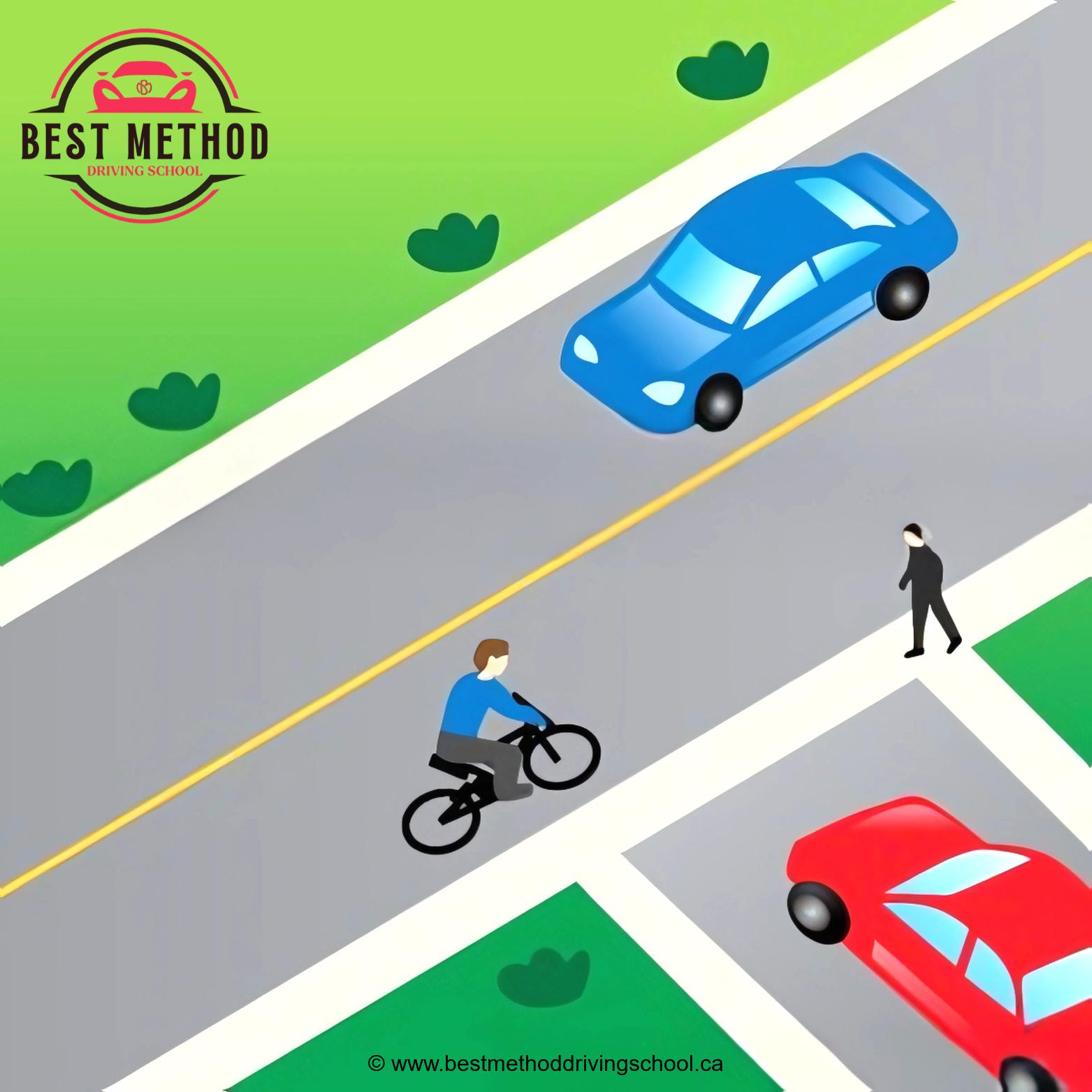
What should drivers do when a car is waiting to allow a pedestrian to cross at a marked crosswalk?
Drivers must not pass vehicles within 30 m of a marked pedestrian crosswalk. If drivers pass the stopped vehicle, they are liable to hit any pedestrian attempting to cross at the crosswalk.
When descending a steep hill, a good, safe driving practice is to:
When descending a steep hill, vehicles naturally speed up. If drivers permit their vehicle to speed up too much, they may lose control of the vehicle. Brakes will slow the vehicle but if the hill is large, drivers should use more than just the brakes. Lower gears slow the motor naturally, thus assisting the brakes in controlling the vehicle. Drivers should not turn off the ignition, as they will not be able to control the vehicle. Placing the vehicle in neutral or engaging the clutch will cause the vehicle to accelerate further as it travels downhill, so these actions are not safe.
When exiting a freeway, the most common mistake drivers make is failing to reduce speed appropriately. Drivers should use the deceleration lane to reduce their speed sufficiently to safely negotiate any curves on the exit ramp, and transition to the speed of local roadways. Drivers should not cut across freeway lanes to exit. If they miss their exit, drivers should continue along the freeway, take the next exit, and readjust their route accordingly.
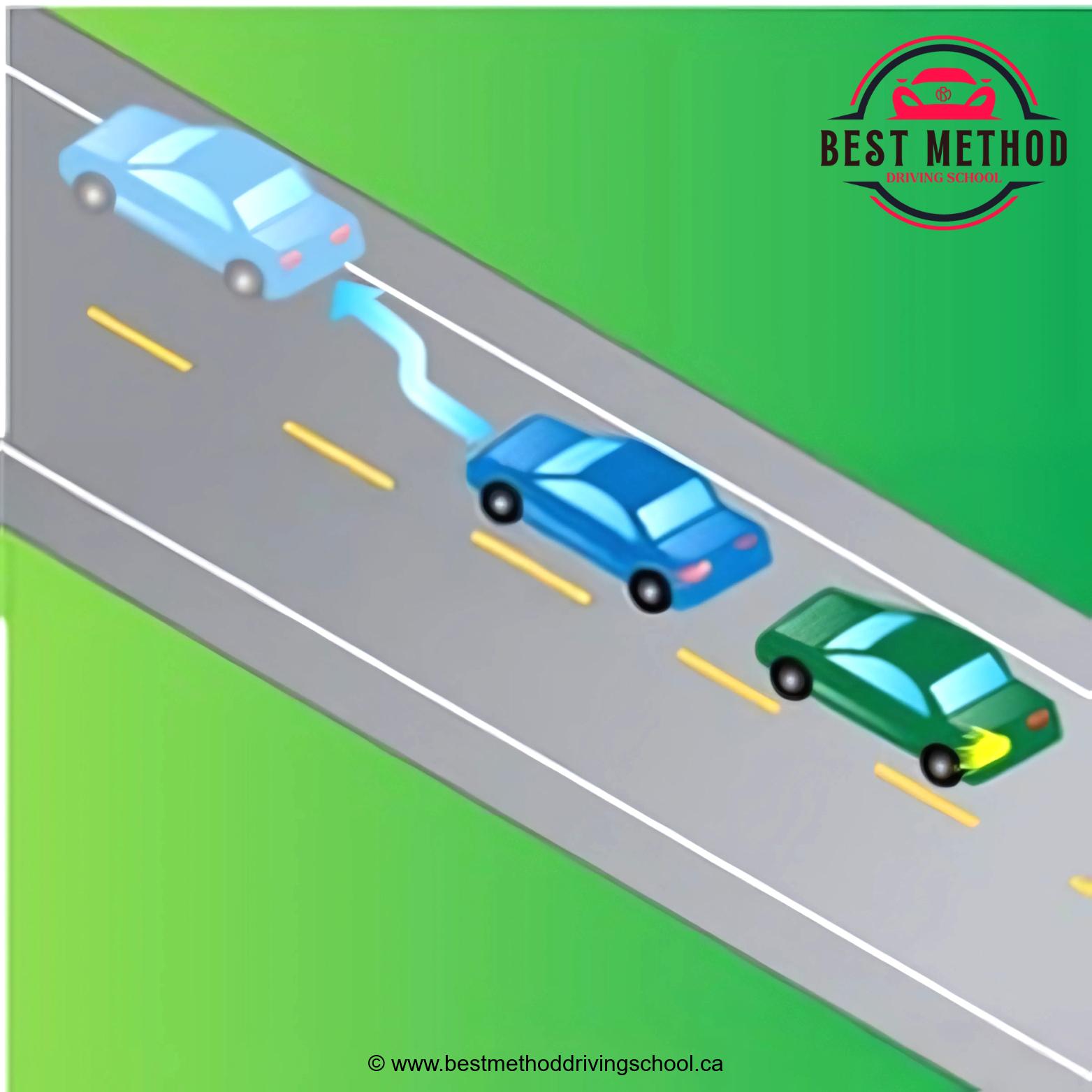
Drivers must always pass other vehicles with caution, even when permitted by lane markings. On a two-lane highway, drivers will have to enter the oncoming traffic lane to pass another vehicle. Drivers must scan the road ahead to determine whether there is sufficient time to pass the vehicle, taking into account any oncoming traffic that is present. In order to pass, drivers must signal their intention, perform a proper mirror and shoulder check, pull to the left and pass the vehicle, leaving a two-second gap behind them and the vehicle that has been passed before returning to the proper driving lane. Drivers should not cut off the vehicle they have just passed, as this could cause an accident.
If a vehicle?s wheels go off the paved road, what should a driver do?
In any emergency situation, it is important that drivers remain calm and maintain control of their vehicle. Often drivers panic and apply the brakes heavily. This could cause skidding and make the situation worse. Jerking the steering wheel quickly to attempt to get back on the road is also likely to result in skidding. Instead, drivers should grip the steering wheel firmly, avoid heavy braking, release the gas pedal so the vehicle will slow naturally, gradually steer the vehicle back onto the paved road, and accelerate up to the speed limit after the tires are back on the roadway.
In good weather conditions drivers are required to keep a safe distance behind the vehicle in front. Drivers should keep at least:
A simple way for drivers to check that they are following a safe distance behind another vehicle is to use a marker such as a road sign and begin counting "one-one-thousand, two-one-thousand,..." from the time the other vehicle passes the sign until the time their vehicle passes the sign. A count of 'two-one-thousand" or higher indicates that the vehicle is at least two second's distance behind the other vehicle. In poor driving conditions, drivers should allow a greater travelling distance to ensure they are able to stop safely if needed.
Drivers licensed under the Graduated Driver License Program are restricted from operating a vehicle:
Under the Graduated Driver License Program, G1 and G2 drivers are not permitted to operate a vehicle after having consumed any amount of alcohol. It is dangerous for all drivers, including those with a G license, to drive after having consumed alcoholic beverages. People should always avoid driving after consuming alcohol: they should get a ride from a designated driver, call a cab, or arrange an alternate form of transportation home.
When is it permissible to use only the parking lights on a vehicle?
When used on their own, parking lights are intended only for parking and are primarily used when parking in dark areas where visibility is required, such as on the shoulder of a highway at night. It is not safe to drive with only the parking lights on. When operating a motor vehicle, drivers must use their full headlight system to ensure their vehicle is visible to other drivers.
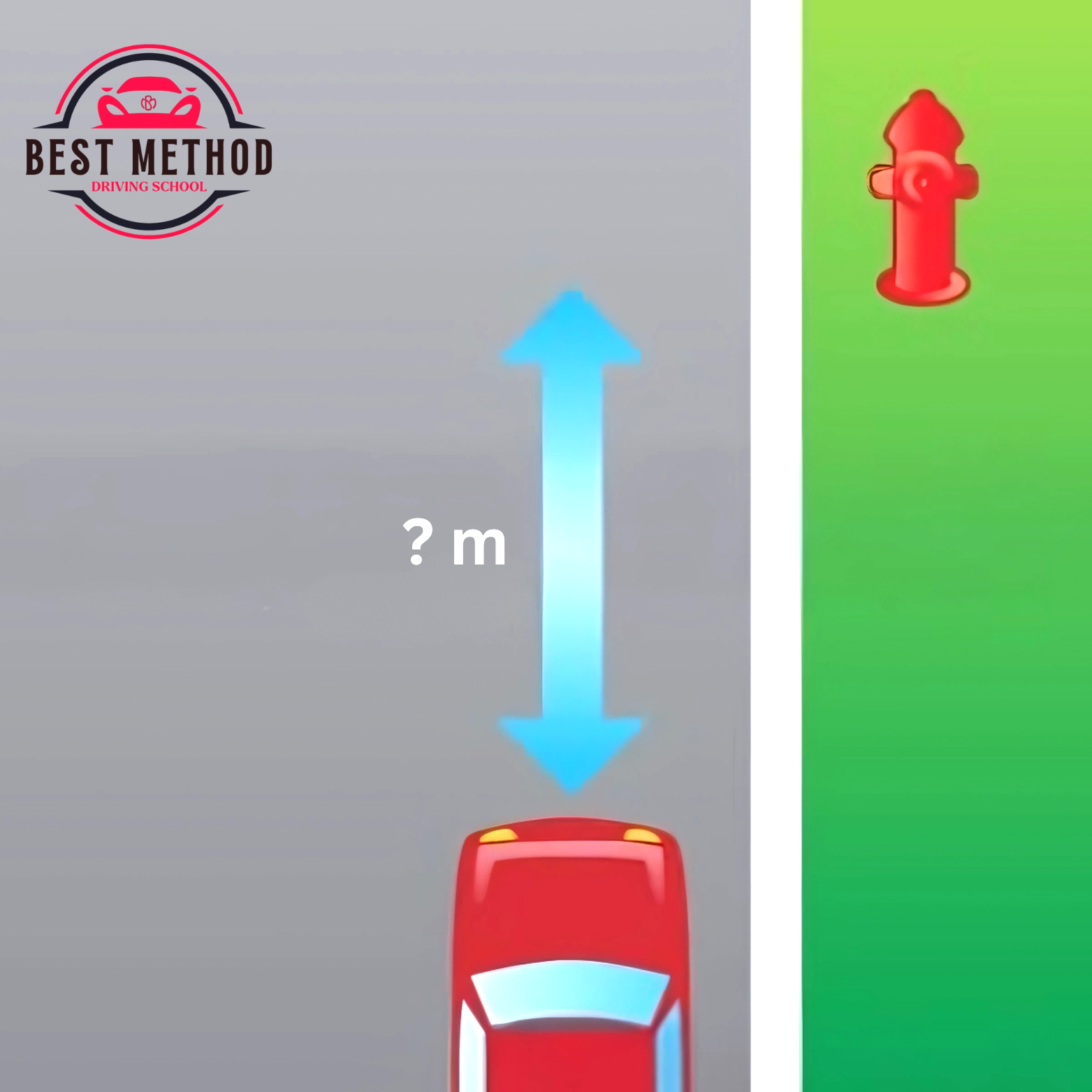
The nearest a driver may park to a fire hydrant is:
Parking too close to a fire hydrant can obstruct fire vehicles and fire fighters from accessing the hydrant when needed. This can endanger others if a fire occurs. In an emergency situation, firefighters have the right to smash windows of vehicles that are obstructing hydrant access, and run their hose through the vehicle; this process is nicknamed "hosing." If a vehicle is hosed, firefighters do not have to pay for repairs: the owner of the vehicle is responsible for repair costs.
Drivers who fail or refuse to give a breath or blood sample when asked by police:
Drivers are required to provide a breath or blood sample when asked by police. Refusing to do so generally indicates to the police that the driver has been drinking, and results in immediate consequences. Whenever drivers are planning to consume alcoholic beverages, the safest practice is to arrange for alternate transportation afterwards. It is dangerous to drive after consuming alcoholic beverages.
In emergency situations such as a tire blowout, drivers need to remain calm. Panic will increase the likelihood of accident and injury. Heavy braking should be avoided in the case of a tire blowout. Drivers should release the gas pedal, which allows the vehicle's speed to decrease naturally. At the same time, drivers should grip the steering wheel firmly and steer in the direction they wish to travel.
G1 and G2 license holders have greater restrictions than drivers who have their full G license because they are still in the process of developing driving skills. To ensure their safety and the safety of others on the road, greater restrictions are imposed on these drivers.
Hydroplaning can cause vehicles to skid. The term "hydroplaning" occurs when:
Any form of moisture on the ground can cause a tire to lift up off the pavement slightly, allowing water to get under the tire and cause hydroplaning. Once this happens, steering ability is temporarily lost because tires are unable to get any traction with the pavement. Drivers should avoid panic, and steer in the direction they wish to travel once the tires regain traction. Drivers should not brake or accelerate suddenly when hydroplaning occurs, as this will cause further skidding.
If a vehicle becomes disabled on a 400-series highway, the driver should:
Being in a disabled vehicle on a highway is potentially quite dangerous. Pull over as far as possible from the highway. Turn on hazard lights if possible. Roll down the window on the driver’s side, hang out a white cloth or piece of paper, and roll the window back up to secure it in place: the cloth or paper alerts other drivers that there is a problem. Drivers should never attempt to walk on a highway.
When deciding to make a U turn, drivers must first observe:
Drivers must not perform U-turns where prohibited. "No U-turn" signs are placed in areas where U-turns are considered to be unsafe due to typical traffic or visibility conditions. To make a U-turn safely, drivers must be able to see at least 150 m in both directions. It is illegal to make a U-turn on a curve in the road, on or near a railway crossing or hilltop, or near a bridge or tunnel that blocks the driver's view. To make the U-turn, drivers should signal a right turn, check their mirror and blind spot and pull over to the right side of the road. Then they should stop, signal a left turn, and when traffic is clear in both directions move forward turning quickly and sharply into the opposite lane. It's important for drivers to continue to check for traffic as they turn.
During poor weather conditions such as rain, snow, smoke and fog, which beam should headlights be on:
Poor weather conditions can decrease visibility considerably. Drivers might think high beam headlights would increase visibility, but in conditions such as heavy rain, snow, smoke or fog, light from high beams reflects back off the particles in the air and actually decreases visibility. Keep lights on low beams under these conditions.
How many days do new Ontario residents have to register their vehicles?
Ontario residents are required to register newly-purchased vehicles, whether new or used, within 6 days of purchase. Drivers need to bring:
1. Their driver’s license.
2. The plate portion of their vehicle permit if they wish to register plates they already have.
3. The completed used vehicle information package when registering a used vehicle.
4. Proof of purchase.
5. The original vehicle permit with the transfer portion completed by the seller.
6. Proof of insurance (required for putting license plates on the vehicle).
7. Proof that the vehicle has passed the Drive Clean emissions test.
Once the vehicle is registered, drivers will be issued a vehicle permit.
On a multi-lane road, the right lane is supposed to be used for travel and for slower traffic, while the left lane is supposed to be used by drivers who are passing a vehicle in the right lane. If a vehicle is approached from behind by another while the driver is using the left lane, the driver of the vehicle should move to the right lane and permit the other vehicle to pass. Drivers who use the left lane to pass another vehicle should move to the right lane after they have completed the pass, if it is safe to do so. Slower drivers should remain in the right lane so that they do not obstruct the flow of traffic.
Unless otherwise posted, the maximum speed limit allowed on a highway outside a city, town, village or built-up area is:
Drivers need to be aware of the permissible speed limits on roadways, and follow the unsigned speed limit rules. In the case given, the maximum speed is 80 km/h.
At 15 demerit points a driver?s license will be suspended for 30 days. After the suspension, the number of demerit points on a fully-licensed driver's record will be reduced to:
Demerit points can be issued against a driver's license for many reasons.? The following website includes a complete list of offenses and resulting demerit points for Ontario drivers: ?http://www.ontario.ca/driving-and-roads/understanding-demerit-points?Demerit point rules for drivers with G1 or G2 licenses are different than those for fully licensed drivers. Novice drivers' licenses are suspended for 60 days if they accumulate 9 demerit points or more.? After the suspension period, their demerit points will be reduced to 4. If a license has been suspended, the driver is not legally permitted to drive a motor vehicle, and must not do so.
Skids can also occur due to tire blowouts, wet, slick road surfaces, or black ice (ice that is transparent and practically invisible to drivers). If a skid occurs, drivers should remain calm, avoid hard braking or quick acceleration, and steer in the direction they wish to travel.
How many demerit points will be recorded against a driver's license if the driver fails to remain at the collision scene?
If drivers are involved in a collision that causes damage in excess of $1000, or in which anyone is injured, they are required by law to call the police and remain at the scene of the accident until the police have arrived and given them permission to leave. Failure to do so may result in high fines, cancellation of insurance, and imprisonment for up to 5 years.
Objects that cannot be seen in a vehicle?s rear and side view mirrors are said to be in the vehicle's:
The blind spot is an area of the vehicle, on each side of the vehicle, where objects simply cannot be seen in any of the mirrors. This is due to limitations of mirrors in all vehicles. Larger vehicles have larger blind spots. The existence of blind spots is why drivers must always perform a proper shoulder check before changing lanes. A good policy for drivers to have is to avoid situations where another vehicle is travelling in their own blind spot and to avoid driving in another vehicle's blind spot as much as possible. To avoid driving in another vehicle's blind spot, either accelerate out of the blind spot or slow down and drop back out of the blind spot, whichever is safest given the road conditions.
 Our Driving Tests